Protests took place in Tel Aviv, Jerusalem, Haifa, and Beersheba, as a survey found broad but uneven support among Jewish Israelis for Operation Roaring Lion.
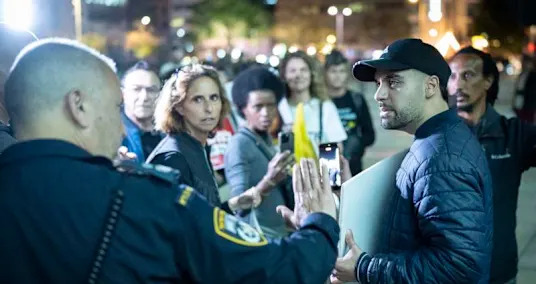
Israel Police arrested 21 anti-war protesters Saturday night as demonstrations against the conflict with Iran expanded in multiple cities despite restrictions on public gatherings.
Protests took place in Tel Aviv, Jerusalem, Haifa, and Beersheba, with hundreds of participants reported in Tel Aviv and Jerusalem and about 100 in Haifa, marking the largest turnout since weekly demonstrations began. Authorities said 13 people were arrested in Tel Aviv and eight in Haifa.
Police said the gatherings were not approved under Home Front Command regulations that ban events with more than 50 people. Officials said the increase in turnout followed calls by groups opposing the government to protest despite the restrictions.
“During a situation assessment that took place at the scene with a Home Front Command representative… it was clarified that there was a real risk to human life and accordingly, Yarkon [precinct] police commander Tzachi Sharabi ordered the gathering to be dispersed,” police said.
Hadash-Ta’al chairman Ayman Odeh, an Arab lawmaker involved in the protests, criticized the police response, calling officers fascists “in the service of the government” and saying they were afraid of “the heroic citizens who went out, despite everything, to make their voice heard.”

Survey shows broad, uneven support for war
The demonstrations come as a March 2026 survey by the Israel Democracy Institute found broad but uneven support among Jewish Israelis for Operation Roaring Lion. Support was strongest on the Right at 87% and about half on the Left.
The survey also found that Jewish and Arab respondents largely agreed that Iran’s resilience has been stronger than expected. Most Jewish respondents said Israeli society could sustain the campaign for up to one month, while 28% said as long as needed. Arab respondents were less optimistic about how long the public could endure the conflict.
A majority of Jewish respondents said Prime Minister Benjamin Netanyahu’s decision was driven by security considerations, while most Arab respondents viewed it as political.
LATEST POSTS
- 1
 Toyota’s Next Big Sports Car Might Apparently Be a Turbocharged All-Paw Beast
 - 2The most effective method to Recognize a Great Lab Jewel
- 3If you want a true taste of Italian paradise, head to Favignana
- 4Collierville residents with no power as temperatures plunge
- 5Terminal cancer diagnosis announced by JFK's granddaughter




- 'Israel has the right to continue its attacks,' Lebanese Foreign Minister announces
- A definitive Bike Standoff: Decision in favor of Your Number one Ride
- 'Stranger Things' Season 5: When does Volume 2 come out? And Volume 3? Everything to know about the remaining episodes before the finale.
- 'Here we go again': Businesses grapple with fuel costs
- EU top diplomat Kallas arrives in Kiev to commemorate Bucha massacre
- Congolese rape survivors search in vain for medicine after USAID cuts
- Watch interstellar comet 3I/ATLAS speed away from the sun in free telescope livestream on Nov. 16
- EU Commission prepares €90bn Ukraine loan despite Hungary's veto
- World leaders, rights groups react to COP30 climate deal